


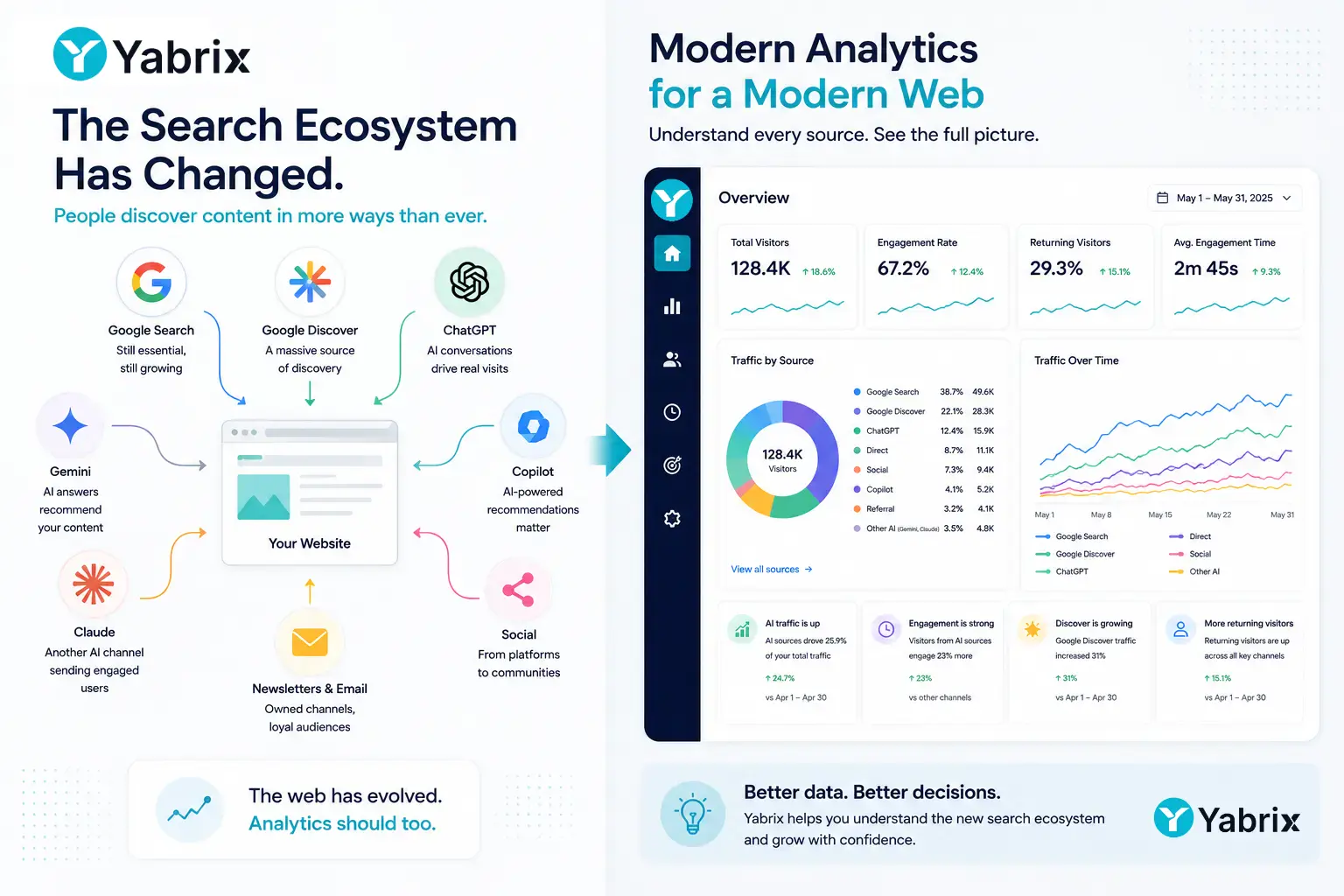
For a long time, the way people found websites was predictable.
Someone had a question. They opened Google, typed it in, clicked a blue link. Maybe they came from Facebook or an email newsletter, but search engines sat at the center of everything.
Analytics platforms were built around that reality. Traffic was sorted into neat buckets: Organic Search, Direct, Referral, Social, Paid. Those categories worked because they matched how people actually moved around the internet.
That model isn't wrong. It's just incomplete now.
Search doesn't mean what it used to
Google Search still matters — a lot. But it's no longer the only place where people stumble onto content.
Google Discover has quietly become one of the largest traffic drivers for publishers. AI assistants like ChatGPT, Gemini, Copilot and Claude now recommend websites directly during conversations. AI Overviews answer some queries before users ever reach the traditional results page.
The path from a question to a website isn't a straight line anymore.
Someone might discover an article through an AI chat, see it again in Discover a day later, then come back through a regular Google search the following week. Labeling all of that as "organic search" flattens the picture.
Where visitors come from is getting harder to categorize
The biggest shift in recent years isn't that Google is going away.
It's that discovery is spreading out.
Websites are starting to pull visitors from a wider mix of sources — AI-generated referrals, Discover feeds, newsletters, niche communities, messaging apps, social platforms — each one bringing people with different habits and expectations.
Looking at total sessions alone hides most of that. Knowing which channels are growing, which are shrinking, and how users behave once they land on a page has become just as valuable as the traffic number itself.
Page views don't tell you much on their own
For a long time, success meant more page views and more sessions.
Those numbers still matter. But alone, they can't answer the questions that actually count.
Did the visitor read the article? Did they explore other pages on the site? Did they come back a week later? Did they arrive from an AI assistant or a traditional search result?
The shift is away from counting visits and toward understanding what people do once they show up. Engagement rates, returning visitor data, scroll depth and traffic source breakdowns often say more than raw session counts.
Analytics platforms need to keep pace
The web won't stop moving. New AI platforms will launch. Search engines will keep changing how they present information. Discovery will keep scattering across more products and devices.
Analytics tools that stay frozen in the old model will miss what's actually happening.
They need to help site owners understand not just how many visitors showed up, but how those visitors got there, what they did with the content, and how newer technologies are shifting user behavior.
The goal isn't to collect more data. It's to collect the right data.
What this means in practice
The search ecosystem is more varied than it's ever been.
Search engines still sit at the core, but they now share the stage with AI assistants, Discover and other channels that barely existed a few years ago.
Making sense of this requires more than traditional reports organized around page views and sessions. It takes a wider lens — one that accounts for how people discover content, how they consume it, and whether they come back.
The web has already changed. The real question is whether the tools we use to measure it have kept up.