



When people talk about website performance, the conversation usually starts with traffic. More visitors sounds like progress. But traffic on its own doesn't tell you much.
What actually matters is what those visitors do once they land on your site.
Do they read? Do they stick around? Do they browse further? Or do they disappear within seconds?
That's the question Engagement Rate answers.
What is Engagement Rate?
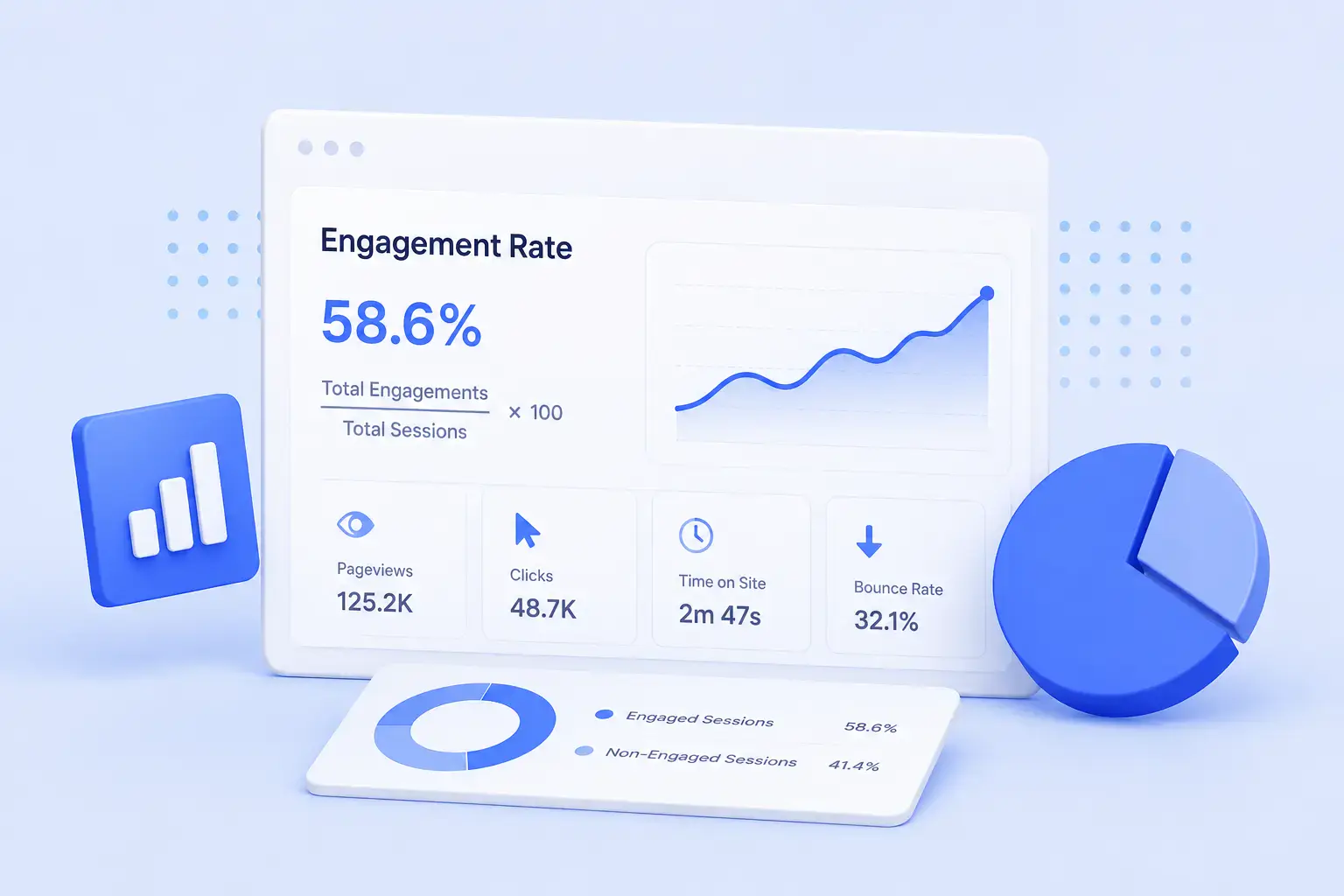
Engagement Rate measures how actively visitors interact with your website, rather than bouncing almost straight away.
Unlike blunt metrics such as page views or session counts, it tells you something about the quality of your traffic. A site with fewer visitors but strong engagement is often in better shape than one pulling in large volumes of traffic that vanishes immediately.
Put simply, Engagement Rate answers one question: are people actually getting something from your website?
How is Engagement Rate calculated?
The formula depends on which analytics platform you use.
Google Analytics 4, for instance, counts a session as engaged if at least one of these conditions is met:
- The visitor stays on the site for 10 seconds or more.
- The visitor views two or more pages.
- The visitor completes a conversion event.
From there, the calculation is straightforward:
Engaged Sessions ÷ Total Sessions × 100
So if your site logs 10,000 sessions and 6,800 of them qualify as engaged, your Engagement Rate is 68%.
Why does Engagement Rate matter?
Not all traffic carries the same weight.
Picture two websites. The first pulls in 100,000 visits a month but has an Engagement Rate of just 20%. The second attracts 40,000 visits with an Engagement Rate of 80%.
On paper, the first site looks stronger because the numbers are bigger. In practice, the second site likely has a more loyal readership, better content and stronger long-term prospects.
A high Engagement Rate tends to signal that:
- Visitors are finding what they came for.
- The content is relevant to them.
- The user experience works well.
- Pages load quickly enough.
- People are browsing beyond the landing page.
It's one of the clearest signs that your audience genuinely cares about what you're publishing.
What counts as a good Engagement Rate?
There's no single benchmark that applies everywhere. An ecommerce site, a news outlet and a SaaS product will behave very differently.
As a rough guide:
- Below 30% — typically considered low.
- 30% to 50% — average.
- 50% to 70% — good.
- Above 70% — excellent.
That said, comparing yourself to other websites is usually less useful than tracking your own numbers over time. If your Engagement Rate climbs from 45% to 60% across six months, that's a strong signal your content and user experience are heading in the right direction.
What affects Engagement Rate?
Content quality is the obvious one. If visitors find useful, well-structured information that answers their questions, they're far more likely to stay and keep reading.
Site speed matters too. Slow pages push people away before they've even had a chance to engage.
Design, readability, internal linking and mobile experience all feed into the number as well. Sometimes even minor tweaks — a clearer headline, shorter paragraphs, a better font size — can move the needle.
Engagement Rate vs Bounce Rate
These two get mixed up regularly, because both try to measure user behaviour. The distinction is fairly simple.
Bounce Rate looks at sessions with little or no interaction. Engagement Rate looks at sessions where meaningful interaction actually took place.
They're opposite sides of the same measurement, but Engagement Rate generally gives you a more useful picture of how valuable your traffic really is. Most analytics platforms track surface-level metrics — pageviews, bounce rates, session duration. Yabrix goes further. It measures how visitors actually interact with your content: where they pause, what they skip, and which sections hold attention. That's the kind of engagement data other tools miss entirely, and it's the data that actually informs better decisions.
Common mistakes when analysing Engagement Rate
The biggest one is staring at the overall percentage and stopping there.
A site-wide Engagement Rate of 60% might be hiding pages that perform brilliantly alongside others that are haemorrhaging visitors. You need to dig into page-level data.
Another frequent error is treating a high Engagement Rate as automatic proof of success. Sometimes visitors spend a long time on a page because they're lost or struggling to find what they need. The number alone doesn't explain intent.
Engagement Rate should always be read alongside other metrics — Active Time, Scroll Depth, Returning Visitors and Conversion Rate all add useful context.
Key takeaways
Engagement Rate tells you how actively visitors interact with your site and whether your traffic is genuinely worthwhile.
A strong rate usually means people are finding value in your content. A weak one can point to problems with relevance, user experience or the quality of traffic you're attracting.
Above all, it's a reminder that website success isn't just about getting people through the door. It's about what happens after they walk in.