



Understand what AI Overviews are, how they work, and why they're reshaping the way people find content through Google Search.
The search page you knew is changing
For years, Google worked the same way. You typed a question, scanned a list of blue links, and picked a page to visit. That routine is shifting.
With AI Overviews, Google now generates answers right at the top of the results page. It pulls information from several websites and stitches together a summary before anyone clicks a single link. That changes how people search. It changes how websites earn attention. And it forces publishers to rethink their SEO playbook.
What exactly are AI Overviews?
AI Overviews are machine-generated summaries placed above the standard search listings. Rather than showing only a ranked list of pages, Google uses generative AI to answer a question directly — drawing from multiple sources and condensing the response into a few paragraphs.
These summaries usually include links to the pages they pulled from, so users can still visit the original content. Google built this feature to speed up answers, especially for questions that would normally require reading across several sites.
When Google decides an AI-generated response would be useful for a given query, it assembles a summary from different web pages.
The summary sits above the organic results. Users can read it and move on, or scroll past it to browse individual websites the traditional way.
Here's the tension: because the overview often covers most of what the user wanted to know, some people stop there. They never click through. Others do — particularly when the cited links promise deeper detail on something the summary only touched on.
This is one of the most significant structural changes to Google Search in recent memory.
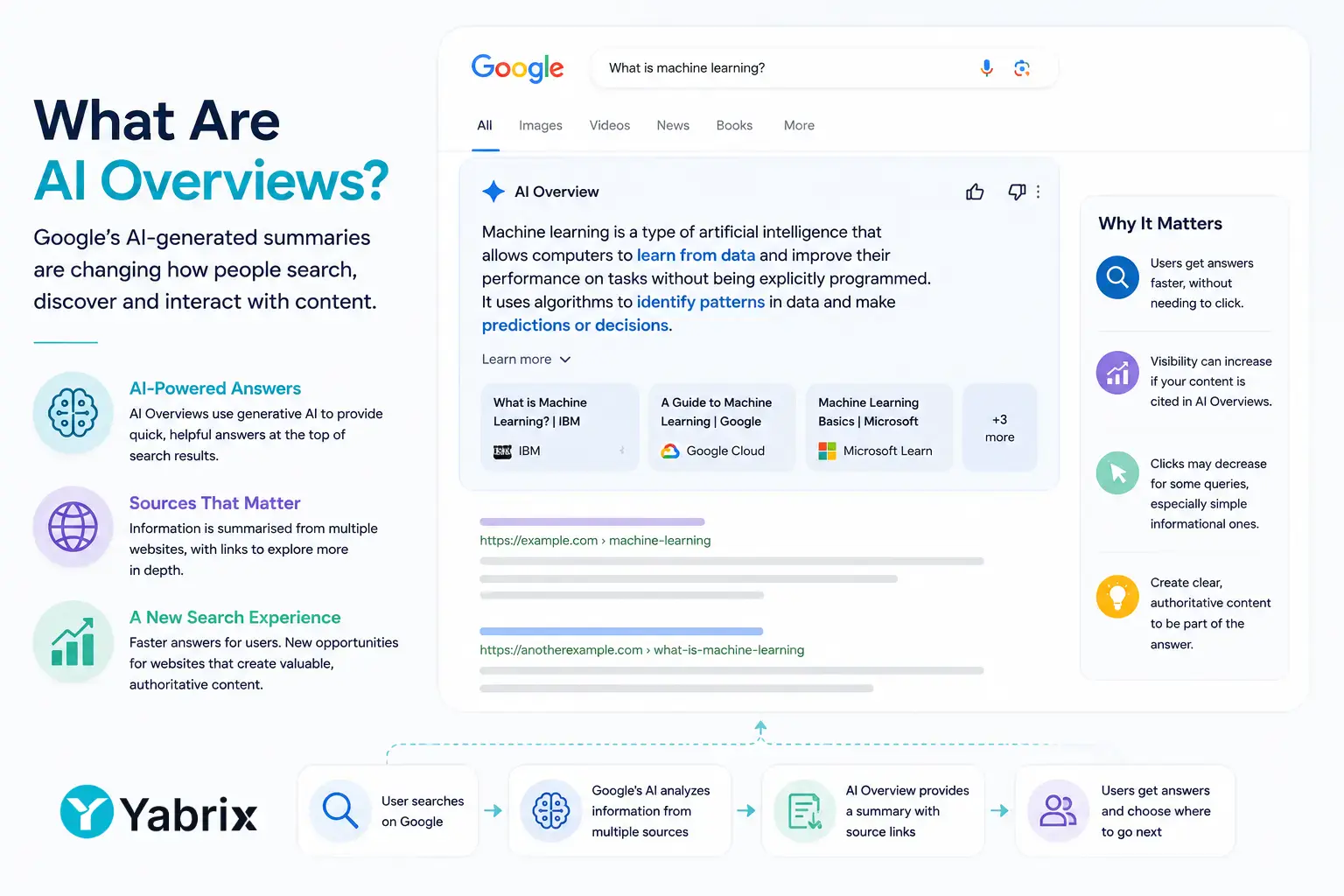
For website owners, the picture is mixed. If your page gets referenced inside an AI Overview, you gain exposure and a degree of trust with the reader. But if the generated answer satisfies the user's question on its own, your page might not get the click it would have earned a year ago.
That doesn't mean organic traffic is vanishing. What it means is that search behavior is moving. Websites now need to think about more than ranking position. They need to produce content that AI systems find worth summarizing and citing.
What this means for SEO
The fundamentals still hold. Well-written content, demonstrated expertise, solid technical performance, and a good user experience — all of that still matters for search visibility.
But there's a new dimension now.
Content that answers questions clearly, shows genuine authority, and includes original thinking is more likely to be pulled into AI-generated summaries. For a growing number of publishers, this has led to interest in what's being called Generative Engine Optimization (GEO) — a practice focused on earning visibility inside AI-generated answers, not just in traditional rankings.
Does this actually reduce traffic?
It depends on the query.
For straightforward factual questions, AI Overviews can cut clicks. The user gets what they need without leaving Google. For more layered topics, the overview can actually drive visits — users see the summary, want more, and follow the cited sources.
Many publishers are also noticing that traffic isn't just shrinking; it's redistributing. Alongside organic search, channels like AI assistants and Google Discover are sending more readers than they used to. Understanding what's really happening requires looking past raw page views and tracking how users arrive across different touchpoints.
What to take from all of this
AI Overviews are Google's way of answering questions inside the search results page itself. They're changing how users find information and how websites earn visibility.
This isn't the end of traditional search. But it is a clear signal that the rules are expanding. Publishers who produce content that's genuinely useful — not just to readers, but to the AI systems summarizing and recommending it — are the ones best positioned to hold their ground.